- World-Renowned Aesthetic Doctors
- Profitable Techniques
- Train in Harley Street, London
- CPD Accredited (56 Hours)
- World-Renowned Aesthetic Doctors
- Profitable Techniques
- Train in Harley Street, London
- CPD Accredited (56 Hours)
Not sure if you’re eligible? Speak with our team. We’ll guide you through the requirements and next steps.
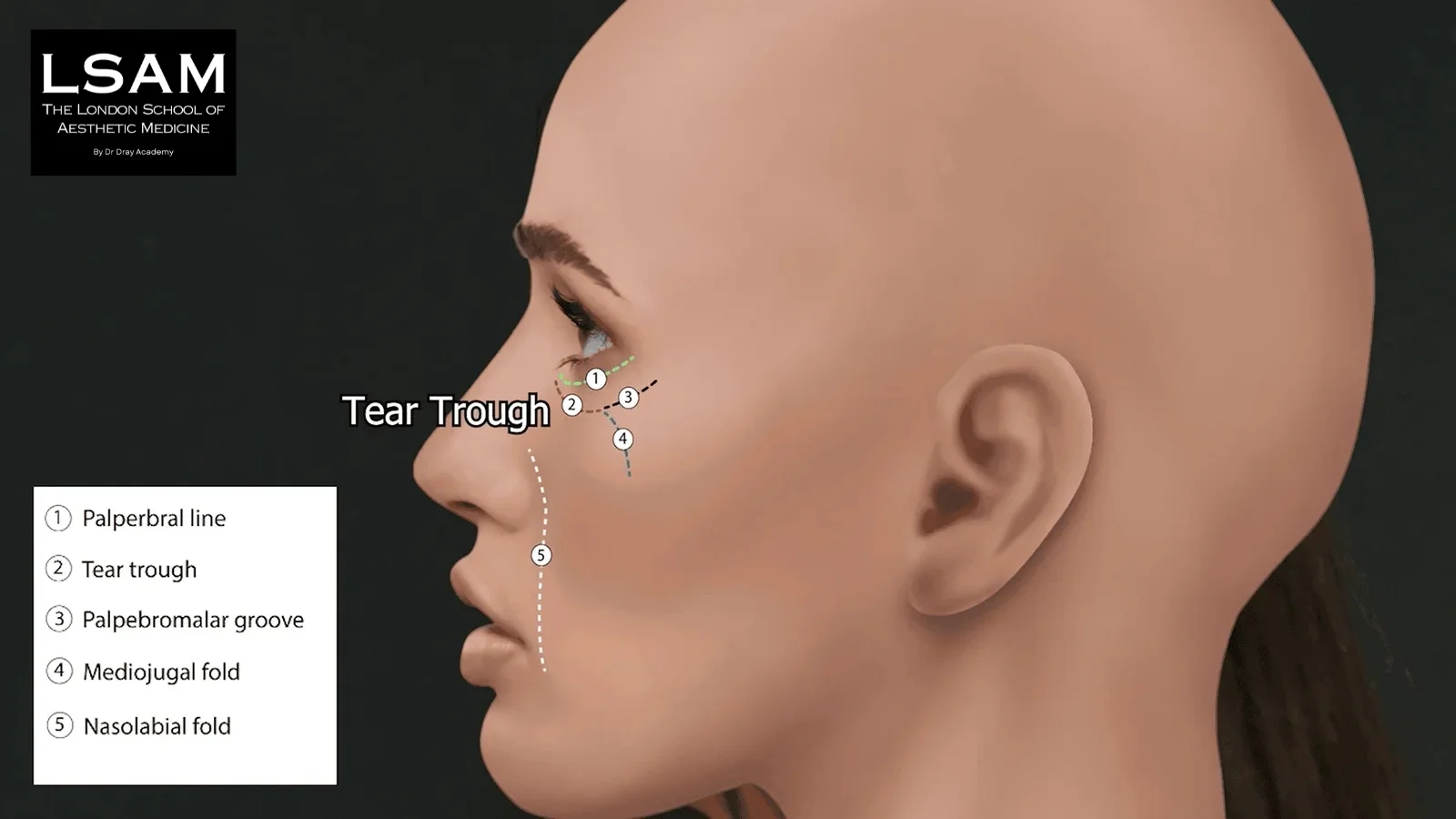
Every injection point in the tear trough is dictated by deep anatomical relationships rather than surface appearance. The infraorbital region is defined by a transition between the lower eyelid and midface, anchored by ligamentous structures that determine how and where hollowness appears.
Key structures influencing injection planning include:
Loss or weakening of these structures creates the characteristic hollowing seen in ageing patients.
Clinically, this means filler placement must respect structural boundaries rather than attempt to simply erase a shadow.
At London School of Aesthetic Medicine, our training is designed to go beyond basic techniques — focusing on the clinical judgement, precision, and full-face understanding required to deliver natural, high-level results.
Our approach is built on over 45 years of experience treating some of the world’s most discerning patients, and these techniques are practiced daily across our London, Paris, and Abu Dhabi clinics.
Successful tear trough treatment starts with careful assessment. Not every patient with “dark circles” needs tear trough filler, and in fact, treating the wrong patient with filler is one of the easiest ways to create an unnatural or problematic result.
The first question is: is there true hollowing, or is the concern mainly darkness, skin quality, pigmentation, or crepiness?
True tear trough hollowing usually occurs when there is volume loss in the sub-orbicularis oculi fat, often referred to as the SOOF. This creates a visible groove or shadow between the lower eyelid and cheek. In these cases, carefully placed tear trough filler can help soften the hollow, support the lid-cheek junction, and reduce the shadowing effect.
However, if the main issue is darkness without hollowing, filler may not be the best option. Darkness can be caused by thin skin, pigmentation, vascular show-through, poor skin quality, or crepiness. In these patients, a regenerative or skin-quality treatment may be more appropriate.
For example, if the under-eye skin is thin, tired-looking, or mildly dark but not hollow, we may use Sunekos, placed superficially in the subdermal plane above the orbicularis oculi muscle, to improve hydration, elasticity, collagen stimulation, and skin brightness.
In older patients with darker, thinner, crepey under-eye skin, polynucleotides may be considered in a similar superficial plane to support tissue repair, improve skin quality, and strengthen the delicate under-eye area over time.
The key point is simple: tear trough filler treats hollowing. It does not treat every type of under-eye darkness.
Tear trough filler can produce beautiful, subtle results when the patient is suitable. However, it is probably one of the easiest filler treatments to get wrong, and the most common reason is poor patient selection.
A good candidate usually has:
A less suitable candidate may have:
In these cases, filler can sometimes worsen the appearance by adding volume to an area that already holds fluid or has poor drainage.
One of the most important questions during assessment is whether the patient wakes up with puffy under-eyes.
If a patient describes regular morning swelling, fluid retention, or puffiness that improves throughout the day, this can suggest poorer lymphatic drainage around the lower eyelid. Tear trough filler, particularly hyaluronic acid filler, can attract and hold water. In patients prone to puffiness, this may increase the risk of prolonged swelling, puffiness, or an overfilled appearance.
This is why we always assess not only the hollow, but also the behaviour of the under-eye area over time.
A patient with a true hollow and no puffiness may be a good filler candidate. A patient with darkness, puffiness, and minimal hollowing may be better suited to skin-quality treatments instead.
The snap test is a simple clinical assessment used to evaluate lower eyelid tone and skin elasticity.
To perform the test, the lower eyelid is gently pulled downward and then released. In a patient with good eyelid tone, the lid should (snap) back quickly into its normal position. If the eyelid returns slowly, remains distracted, or needs a blink to reposition, this may suggest reduced lower eyelid support or laxity.
This matters because patients with poor eyelid tone, loose skin, or weak support may be more prone to swelling, irregularity, or an unsatisfactory result after tear trough filler.
The snap test is not used in isolation, but it forms part of a broader assessment that includes skin quality, lid-cheek anatomy, hollowing, puffiness, facial structure, and medical history.
Once we have confirmed that the patient has true hollowing and is a suitable candidate, tear trough filler can be used to soften the groove and improve the transition between the lower eyelid and cheek.
At Clinic Dr Dray, the goal is always subtle correction. The under-eye is a delicate area, and overfilling can quickly make the result look puffy, heavy, or unnatural.
For this reason, we usually tell patients to expect a 25-50% improvement, not a complete erasure of the tear trough. The aim is to look fresher and less tired while still looking completely natural.
For true tear trough hollowing, we usually use a cannula technique rather than a needle. A cannula is a blunt-tipped instrument that allows controlled placement of filler through a small entry point, helping the practitioner treat the area carefully and conservatively.
A commonly used approach is a 50 mm, 23G cannula, which allows access to the medial tear trough from a safe and controlled entry point placed within reach of the target area.
The filler we often choose is Teosyal Redensity II, a hyaluronic acid filler specifically designed for the under-eye region. It is soft, smooth, and well suited to delicate tissue, making it a good option for subtle correction in this area. It can also be gently massaged and refined after placement, which is important in such a fine anatomical zone.
The filler is placed deep, beneath the orbicularis oculi muscle, rather than superficially in the skin. This helps support the hollow from underneath and reduces the risk of visible lumps or a bluish Tyndall effect.
Treatment is performed gradually, using very small amounts. Rather than placing large volumes at once, we typically place around 0.1 ml at a time, then withdraw, massage gently, and reassess the improvement.
The maximum amount is usually conservative, often no more than around 0.5 ml per side, depending on anatomy. In many patients, less is needed.
In tear trough treatment, it is always better to undertreat than overtreat. Additional product can be added later if appropriate, but overcorrection can be difficult to manage and may create puffiness or an unnatural appearance.
The tear trough is not an area where more filler means a better result. In fact, the opposite is often true.
Too much filler can create:
A refined result comes from placing the right product, at the right depth, in the right patient, using the smallest effective amount.
This is why patient selection, anatomy, product choice, and restraint are so important.
At Clinic Dr Dray, we do not treat every under-eye concern in the same way.
If the issue is true hollowing, tear trough filler may be the most appropriate option.
If the issue is darkness, thin skin, fine lines, or mild crepiness without hollowing, Sunekos may be more suitable. Sunekos is placed superficially above the orbicularis muscle and works by improving hydration, elasticity, and collagen stimulation rather than adding volume.
If the patient has older, thinner, crepey, or more fragile under-eye skin, polynucleotides may be recommended to support regeneration, tissue repair, and skin quality over time.
In some cases, a combination approach may be best. For example, a patient may need a small amount of deep tear trough filler to improve hollowing, alongside Sunekos or polynucleotides to improve skin quality.
The best results often come from understanding which layer of the under-eye is causing the problem.

Tear trough treatment is not simply about placing filler under the eyes. The most important step is deciding whether filler is actually the right treatment.
If there is true hollowing from volume loss, carefully placed tear trough filler can soften the groove and reduce shadowing. If the concern is mainly darkness, thin skin, or crepiness, regenerative treatments such as Sunekos or polynucleotides may be more appropriate.
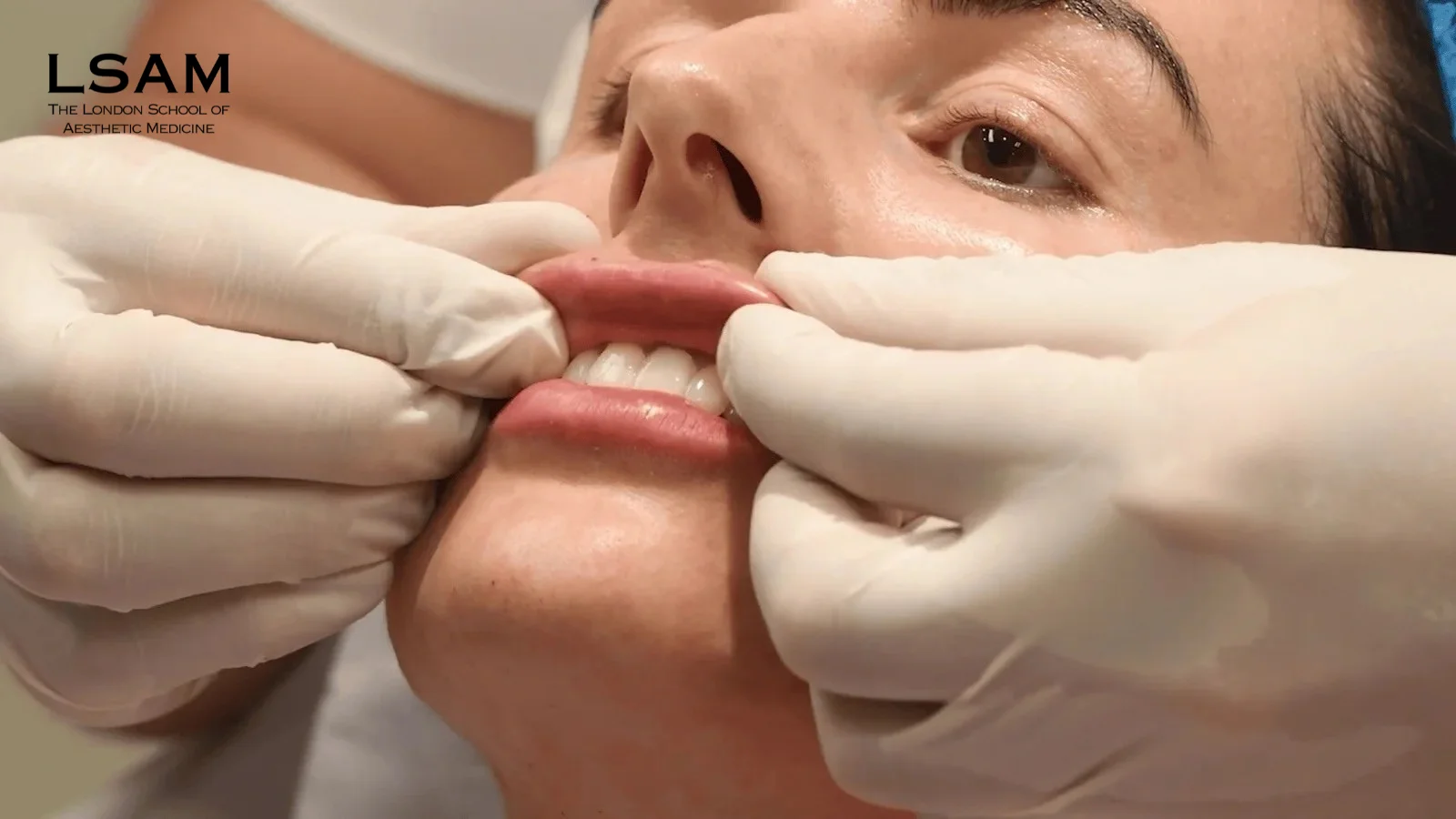
Here you can see delegates performing tear trough filler, under close supervision from our experts during our Harley Street Aesthetic Mastery Training.
If you are looking for aesthetic training in London that goes beyond basic techniques, London School of Aesthetic Medicine offers a clinically-led, full-face approach developed over 45+ years of real patient experience.
Unlike fragmented courses, our pathway teaches you how to assess, plan, and treat the face as a whole — combining dermal fillers, anti-wrinkle injections, skin boosters, and regenerative treatments into one cohesive system.
👉 Explore our full aesthetic training London programmes to see how the pathway works.
Most aesthetic courses in London teach isolated techniques. The London School of Aesthetic Medicine teaches clinical judgement, restraint, and full-face mastery.
Our training is built around the Undetectable Transformation Method™, used daily in leading clinics in London, Paris, and Abu Dhabi — focusing on natural, refined results that patients trust.
With small groups, 50+ hands-on procedures, and ongoing mentoring, you don’t just learn — you leave ready to treat patients confidently.
Our hands-on training takes place in Harley Street, London — one of the world’s most recognised medical districts.
This clinical environment ensures you train at the level expected of high-end private practice, working with real models under close supervision from experienced aesthetic doctors.
Yes — mentoring is a core part of the London School of Aesthetic Medicine pathway.
Beyond the initial training, you receive ongoing clinical support, case guidance, and business insight, helping you transition from learning into real-world practice with confidence.
This is where most practitioners struggle — and where our graduates continue to outperform.
Yes — our pathway is designed for both beginners and experienced medical professionals.
We guide you from foundations → hands-on training → confident practice, ensuring you develop not just technical ability, but the clinical thinking required to deliver safe, high-end results.
Get expert insights on aesthetic training, clinical techniques, and how to build a high-level practice. Join our private list for updates on upcoming training dates and opportunities.

The London School of Aesthetic Medicine is a professional training platform dedicated to providing high-quality education in aesthetics and healthcare treatments. The content published is carefully created and reviewed to ensure accuracy, clarity, and real-world applicability.
Our team focuses on delivering expert guidance, training insights, and up-to-date industry knowledge to help students and professionals succeed in their careers. Each article is designed to be informative, trustworthy, and aligned with the latest standards in the field.
Discover our award winning Aesthetic Training in London here!